

 |
Dr. Damir Ismailović
Technische Universität München
Institut für Informatik I1
D-85748 Garching bei München
Germany
Office 01.07.057
Tel: +49 (89) 289-18230 |
|
| email: This email address is being protected from spambots. You need JavaScript enabled to view it. |
Research Interests
- Serious Games
- Intelligent Learning
Research of methods and algorithms from the following areas: Intelligent Tutoring Systems (ITS), Knowledge Management (KM), Artificial Intelligence (AI), Computational Intelligence (CI), Machine Learning (ML) and Behavioral Analysis (BA) for the applicability to intelligent learning in different domains. - Domain independent intelligent adaptive learning environments
- Application of psychological research results (e.g. behavioral analysis) in software engineering.
- Collaborative software development (more abstract: collaborative knowledge work)
- Knowledge management
- Intelligent tutoring systems
- Human computer interaction
- Intelligent machines: Enabling medium sized companies to profitably integrate RFID technology into its own processes by (the creation of process models and decision support and by) developing new adaptive and intelligent RFID hardware
Teaching
- Programming Mobile Multimedia Applications with the iPhone SDK - The iPhone Praktikum 2009
Description: The aim of this course is to teach iPhone programming with the iPhone SDK. We will cover a variety of topics from usability engineering to new product development. As a vehicle we will define several projects with industrial partners, providing the students with a real problem statement and the experience of communication with a real client. - Programming Mobile Multimedia Applications with the iPhone SDK - The iPhone Praktikum 2010
Description: The objective of this course is the development of applications that experiment with modern user interface requirements. You get to know background, tools and methods required to develop applications for the iPhone OS. - Programming Mobile Multimedia Applications with the iPhone SDK - The iPhone Praktikum 2011
Description: The objective of the iOS Praktikum is the development of applications that experiment with modern user interface requirements. Students get to know background, tools and methods required to develop applications for the iOS. In addition to software engineering concepts like object oriented analysis, design and realization of GUI based applications, they learn the key concepts of usability engineering. Real industrial partners provide their problem statements. Students get real team and project experience while actually using real data and working tightly together with their client. - Serious Games Seminar 2012
- Programming Mobile Multimedia Applications with the iPhone SDK - The iPhone Praktikum 2012
Description:The objective of the iOS Praktikum is the development of applications that experiment with modern user interface requirements. Students get to know background, tools and methods required to develop applications for the iOS. In addition to software engineering concepts like object oriented analysis, design and realization of GUI based applications, they learn the key concepts of usability engineering. Real industrial partners provide their problem statements. Students get real team and project experience while actually using real data and working tightly together with their client. - Smart Games Development Lab Course 2013
Description: The aim of this course is to teach games development with the iPhone SDK. As a vehicle we will define a project with one industrial partner, providing the students with a real problem statement and the experience of communication with a real client. - Serious Games Seminar 2013
- Programming Mobile Multimedia Applications with the iPhone SDK - The iPhone Praktikum 2013
Description: This studio course covers the development of mobile applications for smart devices, ranging from standalone applications, embedded systems including hardware and sensors to the design of modern interfaces for complex business applications. Students learn and apply software engineering and usability engineering techniques. This includes object oriented modeling and system design as well as the realization of graphical user interfaces, usability testing, continuous integration and continuous delivery. Real industrial partners provided the problem statements and acted as clients. Ten companies participated in the iOS Praktikum 2013, each with a different problem statement and its own development team. More than 100 students developed these applications using agile techniques and communicating continuously with their clients. - Smart Games Development Lab Course 2013
Description: The aim of this course is to teach games development with the iPhone SDK. As a vehicle we will define a project with one industrial partner, providing the students with a real problem statement and the experience of communication with a real client -
Software Engineering 1: Softwaretechnik (IN2126)
Fundamentals of software engineering
Process models
Description and modeling techniques
System analysis
Requirements engineering
Software Architecture
Implementation
Testing
Principles of system development
Desired outcome: Participants can learn and apply advanced techniques and methods for the development of complex software systems. -
Engineering Informatics II (IN8012)
Fundamentals of software engineeringProcess models
Modeling with UML
System analysis
Requirements elicitation
Software Architecture
Implementation in Java
Testing
Design Patterns
Databases
Desired outcome: Participants can learn and apply advanced techniques and methods for the development of complex software systems.
Projects

The goal of this project is the development of an intelligent online-learning software. In particular Simballo should support the acquisition of literacy for children aged between 4 and 8.
The aim of our research in this area is to discover synergies between behavioral analysis and software engineering through the realization of an intelligent learning framework.
The research team for Simballo consists of psychologists as well as computer scientists.

The TEAM project addresses the need for a knowledge sharing environment with advanced capabilities suitable for the distributed engineering and management of software systems. The TEAM project aims to develop an open-source software system, seamlessly integrated in a software development environment for enabling decentralised, personalised and context-aware knowledge sharing.

Ziel des Auftaktprojektes „RFID im Mittelstand“ ist es, durch die Erstellung von Vorgehensmodellen und Entscheidungshilfen sowie durch die Entwicklung neuer adaptiver RFID-Hardware v.a. kleine und mittelständische Unternehmen in die Lage zu versetzen, die RFID-Technologie nutzbringend in eigene und Partnerprozesse zu integrieren.
Durch die konsequente Vernetzung interdisziplinärer Zusammenarbeit zwischen Forschung und Wirtschaft im Bereich RFID, soll ein wesentlicher Beitrag zur Sicherung und zum Ausbau von Wertschöpfung und Arbeitsplätzen am Standort Bayern und Deutschland geleistet werden.
Das Projekt „RFID im Mittelstand“ wird von vier Lehrstühlen dreier Fakultäten (Maschinenwesen, Informatik, Elektro- und Informationstechnik) in enger Vernetzung mit der bayerischen Industrie und den Mitgliedsunternehmen der „Vereinigung der Bayerischen Metall- und Elektro-Industrie e. V.“ als Kooperationsprojekt durchgeführt. Ergänzt durch bayerische Unternehmen, die auf dem Gebiet der RFID-Technologie bereits führende Positionen einnehmen soll so der bayerischen Wirtschaft ein Know-how Zugewinn auf dem wichtigen Gebiet der automatischen Identifikation ermöglicht werden.
-

Serious Game Development: Emil & Pauline in the Cave - Math Games 1
https://itunes.apple.com/us/app/emil-pauline-hohle/id542661591?mt=8Kids have a lot of fun meeting bats and goblins while exploring the world of maths with Emil the polar bear and Pauline the penguin. The App playfully provides, deepens, and consolidates the kindergarten and preschool Math skills in five educational games, and one award game that motivates to play again and again.
Thesis Template
- .
Ongoing Master/Bachelor/Diploma Thesis
- Evaluation of Serious Games
- Development of a framework for serious games on mobile devices in the car
- MMO Games on mobile devices
Open Topics (M = Master, B = Bachelor)
- Games Engineering Topics
- Serious Games Topics
- MA: A MMO Strategy Game for Mobile Devices
Finished Master/Bachelor/Diploma Thesis
- Literacy acquisition in serious games: A recommendation framework (Lars Andersen)
- Intelligent Support for non-linear Serious Games (Felix Kaser)
- Ein Framework zur Kollaboration in Multimedia Basierten Digitalen Lernspielen (Mehdi Foudhaili)
- Evaluation of a serious game (Christina Kolb)
- Developement of a framework for game-based learning and implementation of a game (Barbara Köhler)
- Ein Framework für Usability-Monitoring auf mobilen Geräten (Daniel Bader)
- Bug Game: Learning Math in a Serious Game for iPad (Magued Michel George Farah)
- An adaptive serious game for preschool mathematics on mobile end devices (Blagina Simeonova)
- A framework for modul based adaptive Serious Games (Alexander Waldmann)
- A quick prototyping tool for serious games with real time physics (Juan Haladjian)
- Entwicklung einer mobilen Multi-Plattform Softwarearchitektur (Felix Willnecker)
- Evaluation of the Impact of Micro-Adaptivity in Serious Games (Taha Dhiaeddine Amdouni)
- Auswirkungen der Cloud auf die Architektur betriebliecher Anwendungen (Matous Kucera)
- Learning German in a Serious Game for iPad (Tobias Appel)
- Self-organized adaptive tutoring system with user generated content generation (Michael Blazek)
- Interchange format for mobile physics simulation game prototypes (Matthias Schwab)
- Ein Framework für die spielerische online Mehr-Benutzer-Simulation von Schlachtfeldern (Dapeng Liu)
- A Mobile Educational Game for Children Having Dyslexia (Daniel Richter)
- Cydonia 43: Ein gewaltfreier Multiplayer-Taktik-Shooter (Florian Kick)
- Adaptives Master-Slave Videostreaming im Fahrzeug (Frank Ziegler)
- User Interfaces for Keyboard Apps on Stage for Mobile DevicesUser Interfaces for Keyboard Apps on Stage for Mobile Devices (Thomas Walter)
- Game based manipulation of game elements in a mobile multiplayer real time strategy game (Maximilian Jakasovic)
- RoboCONF: A ToolKit for Configuring Robot Simulations(Alejandro Rueda)
- A space combat simulation game for mobile devices (Ivan Bratoev)
- Kundenindividuelle Konfiguration von Schuhen auf mobilen Endgeräten (Tobias Neuner)
- A Framework for Modelling Games on Mobile Devices (Gözde Okul)
- Hordes of Demons: A distributed, cloud-based game balancing Framework utilizing Machine Learning methods (Mustafa Kurtulus Isik)
Publications
Books and Book Chapters/Sections
- F. Willnecker, D. Ismailović, W. Maison, "Architekturen mobiler Multi-Plattform Apps." in Smart Mobile Apps. Springer-Verlag, 2011
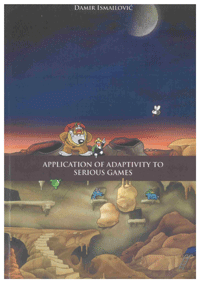 |
Damir Ismailović Application of Adaptivity to Serious Games Publisher: Shaker Verlag, 2012; ISBN: 978-3-8440-1505-8 |